
Notes from a Sojourn
October 11, 2020
Thanksgiving: An Act of Faith and Love
A Sermon for Thanksgiving Sunday (Year A)
Deut. 8.7-18; 2 Cor. 9.6-15; Luke 17.11-19
Lift up your head
Keltie and I are dog owners. We have an eight year old golden-doodle named Ginger whom we love very much. She’s lots of fun, she’s very cuddly, and she loves being outside. What dog doesn’t?

Ginger and I go on lots of walks together. And like a lot of dogs, Ginger’s attention is often fixed firmly on the ground directly beneath her. Head down, nose to the ground, Ginger is absorbed in the smells of our neighbourhood: discarded garbage, prominent tree trunks at key intersections, fire hydrants, neighbours’ lawns and the darting motions of squirrels, cats, and other approaching dogs.
And while Ginger is intently focused on the ground there is not much any of us can do to redirect her attention. Except one phrase. It’s a question, actually. Only two words. And when I say it, it changes everything: “Where’s Keltie?”
Without fail, Ginger’s head will shoot up high from the ground.
Nose high, heart pounding, Ginger will move immediately from a haphazard saunter to a very purposeful trot, her nose rapidly sniffing, scanning the horizon to take everything in around her. You can see it in her whole body: she is marshalling every sense of sight, sound, and feeling to discern where Keltie might be. Her perspective has shifted: what had been a rather distracted and haphazard walk becomes charged with purpose.
Keltie is, in Ginger’s life, a supreme source of companionship, belonging, encouragement, food, treats, and cuddles. And so, when Ginger looks up from the ground to scan the horizon, her perspective shifts: her memories of Keltie and her hope for Keltie powerfully change her experience of the present.
What are you thankful for?
At this time of year, Thanksgiving Weekend, there is a question we often ask one another that has a similar power to change our perspective of the present (and no, it’s not “Where’s Keltie?”, although, that question certainly changes my perspective!). The question is, “What are you thankful for?”
It’s an important question to ask. For some of you, maybe it’s a tradition to ask it around a dining room table this weekend, or with neighbours at the pick up window of Centre 105, or, this year especially, over Zoom, Facetime, or Skype.
It’s an important question because, in order to answer it, we have to lift up our heads, so to speak, and like Ginger, get our noses off the ground directly beneath us. In order to answer “what are you thankful for?” you need to scan the horizon of your life in search of those sources of companionship, belonging, encouragement, food, delight, and wisdom in your life that fill it with meaning and purpose. Only when you’ve taken the time to remember what you’re thankful for can you give thanks. And reflecting on the sources of your gratitude in life can powerfully reshape and deepen your experience of the present.
But there’s something missing from this picture so far. Maybe you’ve sensed it already.
Anyone of us can sift through their memory selectively to extract some sources of happiness for which we feel thankful. But when we start the task of remembering (which is necessary in order to be thankful), we will also confront the different sources of pain, frustration, and suffering that exist in our lives too – things for which we do not feel thankful at all, and justifiably so.
This raises an important question for me:
Does the act of thanksgiving ask me to forget, or suspend my acknowledgement of these difficult and painful things in my life?
Does thanksgiving demand a mental “sleight-of-hand” to trick myself into having a better attitude?
Is thanksgiving really an exercise in evasion, ignoring the whole truth of my life in favour of looking on the bright side of life?
I don’t think so.
Thanksgiving is an act of faith, not simply a feeling
I do think it’s possible for celebrations of thanksgiving to be evasive and superficially sentimental. But they do not need to be. And it’s here that I think we, as followers of Jesus and members of his Body, bring something distinctive to any celebration of thanksgiving that we participate in: for us, thanksgiving is an act of faith, not simply a feeling.
For us, thanksgiving is something we do when we feel especially thankful;
yet it’s also something we do when we don’t feel thankful at all.
That’s why we do it regularly and often.
It’s something we do alone everyday when we pray at home, work, or school;
and it’s something we do together every week when we worship like this.
We give our thanks during Holy Eucharist in The Great Thanksgiving;
and we give our thanks during the Service of the Word in the General Thanksgiving.
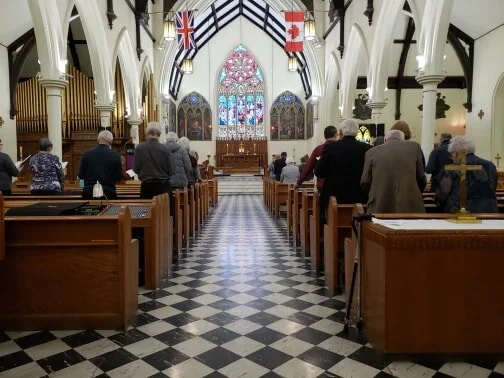
Thanksgiving is a bold statement of confidence in God’s love for us – God’s unwavering faithfulness to forgive, bless, and heal us. Thanksgiving is an act of trust in God’s steadfast love for us, and is, therefore, our act of love for God.
This is why Jesus, when sharing a meal with his friends on the night of his betrayal, arrest, and crucifixion, takes bread and blesses it by giving thanks. It’s not because Jesus is feeling especially thankful for all the terrible things about to happen to him(!). Jesus is enacting his trust in God’s love for him and his disciples in the only appropriate way he can think to do it – with thanksgiving.
Jesus’ Last Supper is an act of trust in his Father’s love for him, and an act of his love for the Father. And our celebration of the Lord’s Supper – our Holy Thanksgiving (eucharistos) – is an act of trust in God’s covenant of love and faithfulness to us; a covenant secured in the life of the Crucified and Risen Christ who holds a place for us in God’s heart now and forever.
Thanksgiving is an act of faith that saves us
Thanksgiving is an act of faith that saves us.
According to Moses, thanksgiving saves us from despairing our lives, and it also saves us from our pride. I’ll give you my paraphrase of what we heard him declare in Deuteronomy this morning: if you’re comfortable, healthy, and rich, do not forget that were once enslaved in Egypt (Deut. 8.12-15). In other words, never forget your exodus. And when you are down in the dumps, remember the future God has promised to everyone who trusts his way of love and lives it (Deut. 8.6-10).
According to the apostle Paul, thanksgiving does not just save us from things, but it also saves us to do things! It saves us from clinging to and boasting about our money and gifts and frees us to share them generously with others. Our generosity builds up our own community life and shows God’s generosity to others, enabling our neighbours to give thanks to their Father in heaven too (2 Cor. 9.6-12).
Finally, Jesus tells us that the faith of the Samaritan leper is the faith that “saves” (Lk. 17.19). What does he mean? The “faith that saves” is the faith that recognizes and acknowledges its true Source… with what? Thanksgiving.
The nine other lepers certainly had some amount of faith – faith enough to leave Jesus to show themselves to the priests – but they fail to turn back to the source of their healing with an appropriate return of thanksgiving. The Samaritan on the other hand, returns to Jesus and glorifies God with his thanksgiving. The healing of this man’s leprosy is cause enough for feeling thankful, yet this specific act of thanksgiving is his recognition of God’s love for him…and his love for God. It is an act of faith that will go on saving him for the rest of his life, a bond of love that will continue to bring healing and transformation the rest of his days.
Thanksgiving is an act of “faith that saves” us.
It is a declaration of our trust in God’s steadfast love for us,
and so it is our act of love for God.
Thanksgiving lifts our heads in search of the One who loves us.
It engages our deep memory of God’s saving work in our past;
and encourages us to discern God’s purposes for us in the days ahead.
It saves us from pride and despair, and delivers us to faith, hope, and love.
Thanksgiving is the only sacrifice that God requires of us.
It is our primary act of worship because it acknowledges our trust in God’s love for us,
and embodies our love for God.
Our thanksgiving, today and always,
nourishes and sustains the covenant of Divine-human love made perfect in Christ,
to channel God’s forgiveness, blessing, and healing in our lives,
and the life the whole world.
Colin+